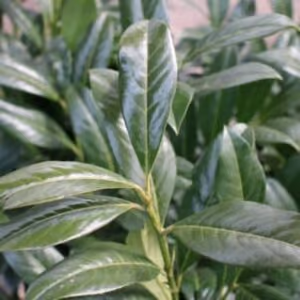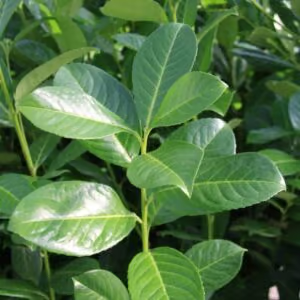


Portuguese Laurel
starting at € 14,95
Ordering Options:
Personal advice
Choose your own delivery date
Free shipping on orders of €750 or more
Top quality from our own nursery

Features
- Luxurious look
- Rock-solid
- Dense and compact growth
- The leaves and berries are poisonous
- Requires good care
- Not very hardy
Order these items at the same time:


Portuguese Laurel
80–100 cm
3 plants per month
In a pot
Price per item:
10+
14.95
50+
14.25
100+
13.50
200+
12.50

Portuguese Laurel
100–120 cm
3 plants per month
In a pot
Price per item:
10+
17.50
50+
16.95
100+
15.95
200+
14.95

Portuguese Laurel
60–80 cm
3 plants per month
Root ball
Price per item:
10+
14.95
50+
14.25
100+
13.50
200+
12.50

Portuguese Laurel
80–100 cm
3 plants per month
Root ball
Price per item:
10+
17.50
50+
16.95
100+
15.95
200+
14.95

Portuguese Laurel
100–120 cm
3 plants per month
Root ball
Price per item:
10+
19.95
50+
18.95
100+
17.95
200+
16.95

Portuguese Laurel
125–150 cm
2.5 plants per month
Root ball
Price per item:
10+
27.50
50+
26.50
100+
24.95
200+
23.50

Portuguese Laurel
150–175 cm
2.5 plants per month
Root ball
Price per item:
10+
32.50
50+
31.50
100+
29.95
200+
27.95
Portuguese Laurel
175–200 cm
2 plants per month
Root ball
Price per item:
10+
54.95
25+
53.50
50+
52.50
100+
49.95
200+
47.50
Portuguese Laurel
200–225 cm
2 plants per month
Root ball
Price per item:
10+
64.95
25+
63.95
50+
62.50
100+
59.95
200+
57.50
Specifications

Full name
Portuguese Laurel / Prunus lusitanica ‘Angustifolia’

Maximum height as a hedge
500 cm

Maintenance
Average

Annual growth
Normal: 20–40 cm per year

Pruning
Once a year

Hardy
Moderate

Evergreen
Yes

Location
Sun, partial shade

Growth Habit
Upright
Reviews
⭐⭐⭐⭐⭐ Absolutely top quality—highly recommended!
We are absolutely thrilled with our beautiful Genolia hedge plants! The quality is outstanding and even exceeded our expectations. From our first contact to delivery, everything went perfectly. Stan was incredibly friendly, helpful, and reliable throughout the entire process. The driver was also exceptionally nice and even helped us unload.
Here, the quality, service, and customer care are simply 100% spot on!
We are overjoyed and would order from here again in a heartbeat. A truly heartfelt recommendation and a well-deserved 5 stars! 🌿
Marco Oelling (Germany)
October 19, 2026

The delivery was excellent, on time, and reliable. The yew trees delivered are of outstanding quality—healthy, strong, and exactly as described. It’s immediately clear that great emphasis is placed on high-quality plants and excellent service. I am completely satisfied and can wholeheartedly recommend this seller. Thank you very much!
Philip G. (Germany)
October 15, 2026
Great experience! Fast service, honest and clear advice—everything was handled perfectly!
Lars Stensen
October 6, 2026
They helped me come up with ideas and offered advice. Great product and great service. Highly recommended.
Thijs Smeets
September 26, 2026
A really great company—the service and quality are outstanding. I can recommend it to everyone.
Robert Jan van den Heuvel
September 26, 2026
I stopped by SVH for advice on hedge plants. Stan really takes the time to figure out which types of hedges are right for you and gives you great advice. In the end, we chose Prunus Elly. It was delivered quickly, and upon delivery, they explained step by step how to plant it. We’re very satisfied!
Rowen Keurentjes
September 21, 2026
It was a pleasure working with you, Stan. Thanks for the lovely laurel wreath and great service!
Arjan Broer
June 15, 2026
Super beautiful plants that more than lived up to what was promised on the website—they were both taller and more beautiful. Superb customer service with quick answers to questions. Fast delivery of the plants to Denmark (don't be afraid to make a bank transfer—you won't get scammed here). The plants are growing fantastically
Thanks, Stan
Lars Mikkelsen (Denmark)
June 3, 2026
We’re very pleased with this nursery! We received a beautiful proprietary variety: the Laurier ‘Elly’. The plants were of good quality, nice and full, and healthy. You can tell right away that they’re grown with a great deal of expertise and care.
In addition, the service was friendly and professional. Everything was delivered neatly, and they kept their promises. We are very happy with the results in our garden and can definitely recommend this nursery to anyone looking for high-quality plants and expert advice.
Pascalle Menting
May 13, 2026
Portuguese Laurel
The Latin name for the Portuguese laurel is Prunus lusitanica ‘Angustifolia’. It’s a beautiful name that does the plant justice. As the name suggests, this laurel species is native to Portugal. The plant also exhibits characteristics typical of the Portuguese climate. For example, this species is more tolerant of drought but less tolerant of cold winters than other laurel species.
Nevertheless, thislaurelis incredibly popular in the Netherlands. In recent years, it has become increasingly common to find this plant in gardens. One of the reasons for this is undoubtedly the plant’s leaves. Because this variety has smaller leaves than other laurel species, it gives the plant a luxurious, distinctive look.
Another added benefit of the Portuguese laurel is that this hedge plant can be planted successfully in virtually any type of soil, so it will take root and grow.
Immediately after planting, this variety of laurel may still be vulnerable, so it’s important to give the plants plenty of care. Planting during a heat wave or periods of extreme frost is therefore not advisable.Laurel ‘Bonaparte’andLaurel ‘Elly’arevarieties that are more tolerant of extreme weather conditions.
This species grows more slowly than other laurel varieties—about 20 to 40 cm per year. The advantage of this is that the Portuguese laurel is ideal for use as a low hedge, for example, in front of your house.
FAQ
-
Portuguese Laurel (Prunus lusitanica 'Angustifolica') is an evergreen shrub known for its glossy, dark green leaves and narrow, upright growth habit. As its name suggests, this plant is native to Portugal and is popular for its luxurious appearance and versatility in gardens. It is an excellent choice for creating hedges or for use as a specimen plant.
-
Portuguese laurel has several benefits:
Luxurious appearance: The glossy leaves add an elegant touch to any garden.
Privacy and shelter: This plant responds well to pruning and forms dense hedges, providing privacy and shelter.
Low maintenance: The Portuguese laurel requires minimal care and can thrive in a variety of environments, as long as the soil is well-drained.
-
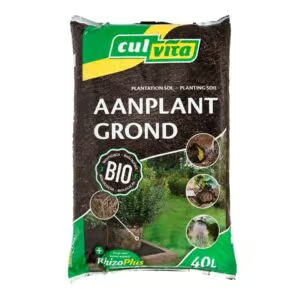
For best results, plant the Portuguese laurel in well-drained soil, preferably in full sun to partial shade. Dig a trench and leave at least 5 cm of space on all sides of the plant’s root ball. This will give you enough room to position the plant neatly in the trench and to add any planting soil as needed.
-
In the first few years after planting, the Portuguese laurel needs to be watered regularly, especially during dry periods. Make sure the soil remains moist, but not too wet, to prevent root rot. Mature plants are fairly drought-tolerant and require less frequent watering.
-
The Portuguese laurel is not very hardy and can be vulnerable during periods of extreme cold. In areas with harsh winters, it is advisable to take extra precautions, such as covering the plants with a cloth or tarp.
-
Portuguese laurel requires moderate care. Pruning is important to maintain the desired shape and density. This is best done in the spring or fall. It is also important to check regularly for pests and diseases.
-
Check regularly for symptoms such as discolored or wilted leaves, and watch for pests such as spider mites or fungi. Proper care, including timely pruning and fertilizing, is essential for the plant's health.
-
This plant grows best in well-drained, fertile soil with a neutral pH. Full sun or partial shade is ideal, but it can also survive in shady areas, albeit with slower growth.
-
Portuguese laurel can be affected by pests such as spider mites and aphids, as well as fungal infections like powdery mildew. Symptoms include discolored leaves and wilting. Regular inspection and good air circulation are essential to prevent these problems.
-
Portuguese laurel can be used to create formal hedges, as a solitary accent plant, or in mixed borders. Its luxurious appearance makes it an excellent choice for framing paths and driveways.
-
Portuguese laurel has an average growth rate of 20 to 40 cm per year, depending on growing conditions. As a result, the hedge normally only needs to be pruned once a year.