

Bay Laurel ‘Rotundifolia’
starting at € 12,50
Ordering Options:
Personal advice
Choose your own delivery date
Free shipping on orders of €750 or more
Top quality from our own nursery

Features
- Growing rapidly
- Suitable as a tall hedge
- Grows rapidly after pruning
- A Dense Hedge in No Time
- The leaves and berries are poisonous
- Susceptible to plant diseases
- Not very hardy
Order these items at the same time:

Bay Laurel ‘Rotundifolia’
100–120 cm
2.5 plants per month
In a pot
Price per item:
10+
14.95
50+
14.25
100+
13.50
200+
12.50
Bay Laurel ‘Rotundifolia’
120–140 cm
2.5 plants per month
In a pot
Price per item:
10+
17.50
50+
16.95
100+
15.95
200+
14.95

Bay Laurel ‘Rotundifolia’
140–160 cm
2 plants per month
In a pot
Price per item:
10+
37.50
25+
36.50
50+
34.95
100+
32.50
200+
29.95

Bay Laurel ‘Rotundifolia’
80–100 cm
3 plants per month
Root ball
Price per item:
10+
12.50
50+
11.95
100+
10.95
200+
9.95

Bay Laurel ‘Rotundifolia’
100–125 cm
3 plants per month
Root ball
Price per item:
10+
14.95
50+
14.25
100+
13.50
200+
12.50

Bay Laurel ‘Rotundifolia’
120–140 cm
2.5 plants per month
Root ball
Price per item:
10+
17.50
50+
16.95
100+
15.95
200+
14.95
Bay Laurel ‘Rotundifolia’
140–160 cm
2 plants per month
Root ball
Price per item:
10+
19.95
50+
18.95
100+
17.95
200+
16.95
Bay Laurel ‘Rotundifolia’
175–200 cm
2 plants per month
Root ball
Price per item:
10+
39.95
25+
38.95
50+
37.50
100+
34.95
200+
32.50
Bay Laurel ‘Rotundifolia’
200–225 cm
2 plants per month
Root ball
Price per item:
10+
54.95
25+
53.50
50+
52.50
100+
49.95
200+
47.50
Specifications

Full name
Laurel ‘Rotundifolia’ / Prunus laurocerasus ‘Rotundifolia’

Maximum height as a hedge
500 cm

Maintenance
Average

Annual growth
Rapid, >40 cm per year

Pruning
Twice a year

Hardy
Moderate

Evergreen
Yes

Location
Sun, partial shade, shade

Growth habit
Bushy, upright
Reviews
Bay Laurel ‘Rotundifolia’
The Latin name for the “Rotundifolia” laurel is Prunus laurocerasus “Rotundifolia.” The “Rotundifolia” laurel is the most commonly planted laurel in the Netherlands. The “Rotundifolia” has long been a very popular plant in the Netherlands. There are several reasons for this.
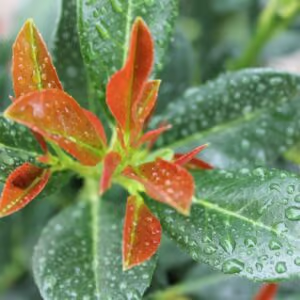
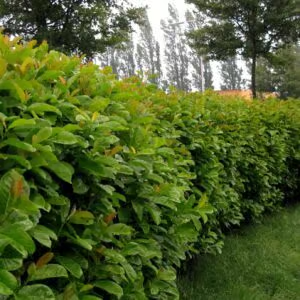
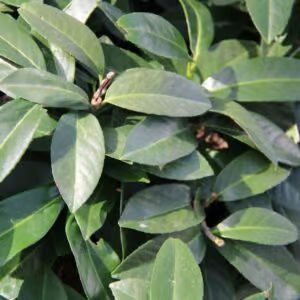
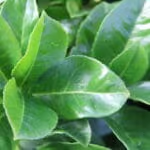
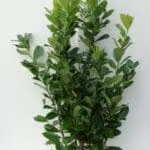
Undoubtedly, one of the reasons is that the “Rotundifolia” is the fastest-growing variety of laurel. This allows you to quickly grow a dense and tall hedge. Another characteristic of this variety is its large, broad, light-green leaves.
The ‘Rotundifolia’ also has a broad growth habit. Are you looking for a hedge that can grow tall and wide? Then the ‘Rotundifolia’ is an excellent choice for your garden!
Because thislaurelgrows quickly and spreads widely, we recommend pruning this hedge at least twice a year. The best time to prune your laurel hedge is in the spring (March through May) and in the fall (September through November).
This laurel has one flowering season. This occurs in the spring, around April or May. At that time, small white flowers appear among the green leaves. These flowers attract butterflies. Red berries may also appear on the branches during this time. These berries, in turn, attract birds.
One drawback of the ‘Rotundifolia’ is that this variety of laurel is susceptible to plant diseases. Are you looking for a similar variety that isn’t susceptible to plant diseases? Then choose Bay Laurel ‘Novita’ The ‘Rotundifolia’ also cannot withstand extreme winter weather.
FAQ
-
Laurel 'Rotundifolia', also known as the round-leaved laurel, is a popular evergreen shrub often used as a hedge plant. This variety has distinctive, round leaves that turn a light green color, adding a lush touch to any garden. Native to the Mediterranean region, this laurel is well-adapted to various climates and is widely planted in the Netherlands and other parts of Europe.
-
Bay 'Rotundifolia' needs to be watered regularly, especially in the first few months after planting. About 10 liters of water per plant per week during dry periods. Make sure the soil is moist but not too wet to prevent root rot. Mature plants are fairly drought-tolerant, but during dry periods, it is advisable to water them more frequently.
-
Generally speaking, the 'Rotundifolia' laurel is moderately hardy. In general, the 'Rotundifolia' laurel can withstand Dutch winters well. If it gets very cold, it’s a good idea to protect your hedge. You can do this, for example, by covering the hedge with a cloth or tarp.
-
Bay laurel 'Rotundifolia' grows rapidly, at a rate of about 40 to 60 cm per year, depending on growing conditions. This makes it an excellent choice for people who want a dense hedge quickly.
-
The best time to plant Laurier 'Rotundifolia' is in the spring (March through May) or in the fall (September through November). During these periods, temperatures are moderate and the likelihood of extreme weather conditions is lower, which improves the chances of the plant taking root and growing.
-
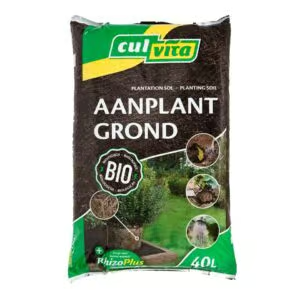
Bay laurel 'Rotundifolia' thrives best in well-drained, fertile soil. A slightly acidic to neutral pH is ideal. Adding compost or organic matter to the soil can improve drainage and fertility, which contributes to healthy growth.
-
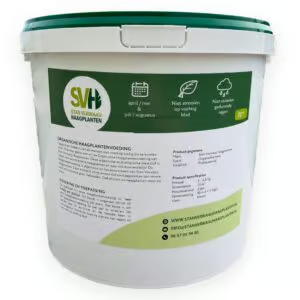
Yes, Laurier 'Rotundifolia' benefits from annual fertilization. In the spring, it is recommended to use the Organic Hedge Plant Fertilizer from Stan Verwaaij Haagplanten, which is rich in nitrogen, phosphorus, and potassium. This promotes growth and helps the plants stay healthy.
-
A healthy Laurier 'Rotundifolia' has full, glossy leaves without spots or discoloration. The branches should be sturdy and upright, and there should be no signs of wilting or damage. Regular inspection helps detect problems early.
-
Bay laurel 'Rotundifolia' can tolerate some shade, but it thrives best in full sun or light shade. In shady areas, growth may be slower and the foliage may be less dense.
-
Yes, Laurier 'Rotundifolia' is well-suited to urban environments. It can tolerate pollution and is relatively low-maintenance, making it an excellent choice for urban gardens and parks.